
Crossing That Dark River
We have assaulted death, yet forgotten how to die.

Part three in a series on medical assistance in dying:
Sometimes, in the sturm und drang of a world gone mad, there comes through the chaos and insanity some brief moment of clarity. Such times pass by quickly, and are quickly forgotten — as this brief instance might have been, but for the courtesy of my neighboring bell weather state of Oregon:
Last month her lung cancer, in remission for about two years, was back. After her oncologist prescribed a cancer drug that could slow the cancer growth and extend her life, she was notified that the Oregon Health Plan wouldn’t cover it.
It would cover comfort and care, including, if she chose, doctor-assisted suicide.
… Treatment of advanced cancer meant to prolong life, or to change the course of this disease, is not covered by the Oregon Health Plan, said the unsigned letter she received from LIPA, the company that administers the health plan in her county.
Officials of LIPA and the state policy-making Health Services Commission say they’ve not changed how they cover treatment of recurrent cancer. But local oncologists say they’ve seen a change, and their Oregon Health Plan patients with advanced cancer no longer get coverage for chemotherapy if it is considered “comfort care.” This does not align with the standards of care specified in the oncology community, an oncologist at Willamette Valley Cancer Center stated.
Studies have demonstrated that chemotherapy decreases pain, reduces hospital admissions, and increases the quality of life in patients with a poor prognosis. The Oregon Health Plan began such rationing of health care in 1994.
We have arrived at last. The destination was never in doubt once the threshold of medical manslaughter had been breached. Wrapped as always in comforting words of “compassion” and “dignity,” it was only a matter of time before our pragmatism trumped our principles. Once the absolute that physicians should be healers not hangmen was heaved overboard, it was inevitable that the relentless march of relativism would reach its logical port of call.
This principled altruism transcended and transformed all we were and were to become, making us unique among creation, not only in the foreknowledge of our death, but our transcendence of death itself. Life had meaning beyond the grave — and therefore far more weight at the threshold of the tomb. Suffering became more than mere fate, but rather sacrifice and purification, preparation and salvation. The wholeness of the soul trumped the health of the body; death was transformed from hopeless certainty to triumphant transition.
Death, after all, is expensive — the most expensive thing in life. It was not always so. In the remote past, it was the very currency of life, short and brutal, with man’s primitive intellect and impulse sufficient solely to deal out death, not defer it. There followed upon this time some glimmer of light and hope, wherein death’s timetable remained unfettered, but its stranglehold and certainty were tempered by a new hope and vision of humanity. We became something more than mere mortal creatures, something extraordinary, an unspeakable treasure entombed within a fragile and decomposing frame. We became far more than our mortal bodies; we became something greater than our pain, someone whose beauty shown through even the ghastly horrors of the hour of our demise. Our prophets — then heeded — triumphantly thrust their swords through the dark heart of death: “Death, where is your victory? Death, where is your sting?” We became in that moment something more than the physical, something greater than our short and brutish mortality. We became, indeed, truly human, for the very first time.
But we knew better. We pursued the good, only to destroy the best. We set our minds to conquer death, to destroy disease, to end all pain, to become pure and perfect and permanent. We have succeeded beyond our wildest dreams. The diseases which slaughtered us were themselves slain; the illnesses which tortured and tormented us fell before us. Our lives grew longer and healthier, more comfortable and productive. Our newfound longevity and greater health gave rise to ever more miracles, allowing us to pour out our intemperate and precipitous riches with drunken abandon upon dreams of death defeated.
Yet on the flanks of our salient there lay waiting the forces which would strangle and surround our triumphant advance. Our supply lines grew thin; the very lifeblood of our armies of science and medicine — that which made our soldiers not machines but men — grew emaciated and hoary, flaccid and frail. We neglected the soul which sustained our science; the spirit which brought healing grew cachectic and cold.
So here we stand. We have squandered great wealth to defeat death, only to find ourselves impoverished and turning to death itself for our answers. The succubus we sought to defeat now dominates us, for she is a lusty and insatiable whore. We have sacrificed our humanity, our compassion, our empathy, our humility in the face of a force far greater than ourselves, while forgetting the power, grace and vision which first led us and empowered us on this grand crusade. Our weapons are now turned upon us; let the slaughter begin.
We will, no doubt, congratulate ourselves on the wealth we will save. We will doubtless develop ever more ingenious and efficient means to facilitate our self-immolation, while comforting ourselves with our vast knowledge and faux compassion. Those who treasure life at its end, who find in and through its suffering and debilitation the joy of relationships, and meaning, and mercy, and grace, will become our enemies, for they will siphon off mammon much needed to mitigate the consequences of our madness.
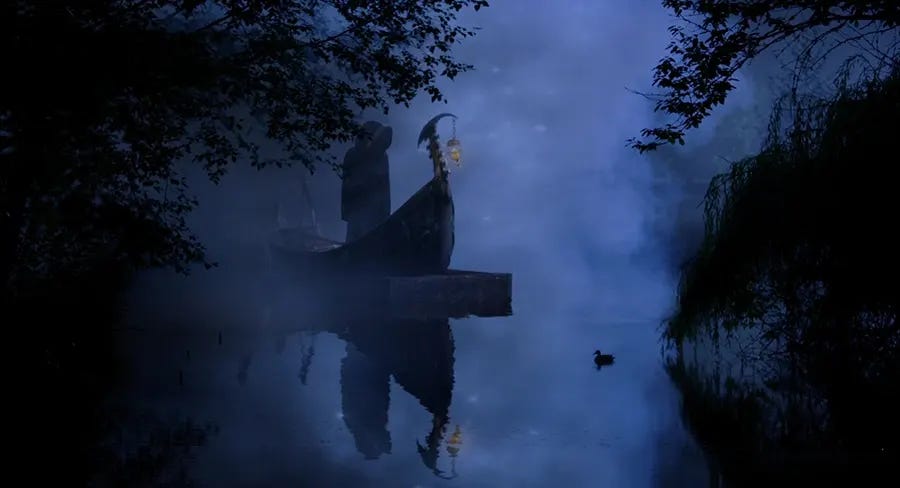
It has been said, once, that where our treasure is, there will our heart be also. We have poured our treasure in untold measure into conquering death — finding succor in our victories, while forgetting how to die. The boatman now awaits us to carry us across that dark river — and we have insufficient moral currency to ignore his call.